
Ivermectin vs Praziquantel: Understanding Antiparasitic Drug Classes
 Trusted SourceAmber Afzal, MDAmber Afzal, MD, is a physician specializing in hematology and medical oncology, with expertise in blood disorders and cancer-related conditions. She is an I…View moreWritten by Shawn Winslet
 Trusted SourceShawn WinsletShawn Winslet is an author at BuyZiverdoKit.com, contributing informative articles and educational content related to medications, pharmaceutical products, a…View morePublished:
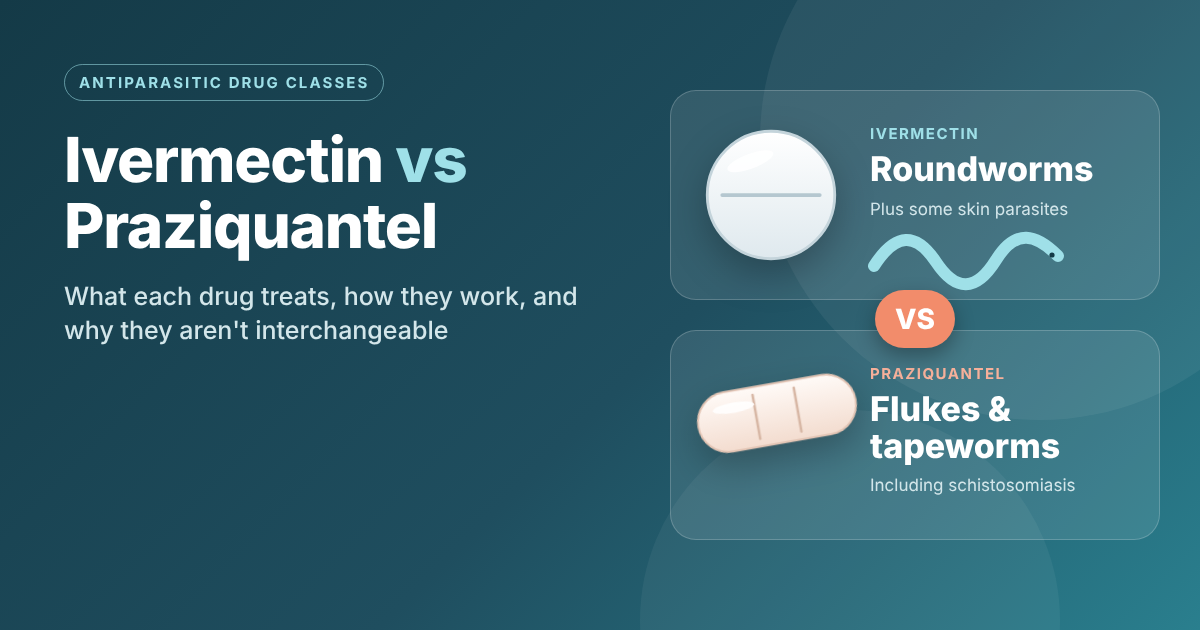
Ivermectin and praziquantel both get called “dewormers”, and both show up in the same searches, so it’s easy to assume they do the same job. They don’t. Ivermectin vs praziquantel is really a question about parasite types: one drug is built for roundworms and certain skin parasites, the other for flukes and tapeworms. This guide explains the drug classes behind them, how each medicine works, and why one can’t simply stand in for the other.
The Short Answer
Ivermectin and praziquantel are both anthelmintics, which is the medical term for drugs that act against parasitic worms. That’s where the overlap ends.
Ivermectin is aimed at nematodes, or roundworms, such as the ones behind strongyloidiasis and river blindness (onchocerciasis). It’s also used against some external parasites like scabies mites and lice.
Praziquantel is aimed at trematodes (flukes) and cestodes (tapeworms). It’s the standard treatment for schistosomiasis and for human tapeworm infections.
Both are prescription medicines. Which one a doctor chooses depends entirely on which parasite has been identified.
Antiparasitic Drug Classes in Plain English
Parasites fall into three broad groups, and medicines are matched to them accordingly.
- Protozoa: single-celled organisms such as the ones behind malaria and giardiasis. These are treated with antiprotozoal drugs, including metronidazole and the artemisinins
- Helminths: parasitic worms. These are treated with anthelmintics, which are split further by worm type: roundworms (nematodes), flukes (trematodes), and tapeworms (cestodes)
- Ectoparasites: parasites that live on the skin, such as scabies mites and lice. These are treated with ectoparasiticides like permethrin
Ivermectin sits in an unusual spot. It belongs to the avermectin family and is sometimes called an endectocide because it works on both internal worms and some external parasites. Praziquantel is a more specialist drug, used mainly against flukes and tapeworms.
This is the reason a single “best dewormer” doesn’t exist. A drug that paralyzes one kind of worm can leave another completely untouched.
How Ivermectin Works
Ivermectin binds to channels called glutamate-gated chloride channels, which are found in the nerve and muscle cells of nematodes and other invertebrates. Once it binds, chloride floods into the cell, the cell becomes hyperpolarized, and the parasite is paralyzed and dies.
People are largely spared because these channels aren’t found in human cells in the same way, and ivermectin doesn’t readily cross into the human brain at normal doses.
The U.S. label approves ivermectin tablets for two conditions: intestinal strongyloidiasis and onchocerciasis. It’s also prescribed off-label for scabies and other parasitic infections, based on guidelines and clinical evidence.
Dosing is weight-based. For strongyloidiasis, health guidance recommends 200 micrograms per kilogram, usually as a single dose on an empty stomach, with follow-up stool tests to confirm the infection has cleared. Onchocerciasis often needs repeat doses months apart, because ivermectin doesn’t kill the adult worms.
How Praziquantel Works
Praziquantel takes a different route. It disrupts how calcium moves across the worm’s outer surface, which causes the muscles to contract and the parasite to become paralyzed. Research points to a calcium channel found in schistosomes, called TRPM_PZQ, as a key target.
Once the worm is paralyzed and its surface is damaged, the body’s immune system can clear it.
Praziquantel is the recommended treatment for all forms of schistosomiasis, and it’s the drug of choice for human tapeworm infections. It’s also used against liver flukes such as Clonorchis sinensis and lung flukes such as Paragonimus westermani.
Dosing is again based on body weight. Tapeworm infections are often treated with a single dose. Schistosomiasis and fluke infections use higher doses, divided across several tablets over one day. Tablets are usually taken with water and a meal and swallowed whole.
Why Ivermectin Can’t Replace Praziquantel
This is the point most comparison pages skip. Ivermectin works through channels that flukes and tapeworms don’t rely on in the same way, so it has little to no effect on them.
A 2024 study in infected mice tested exactly this. Ivermectin, even at a high dose, did not reduce worm numbers or liver damage from schistosomes, while a comparison drug did. The researchers concluded that ivermectin is not an alternative to praziquantel. It’s animal data, but it fits what’s known about how the two drugs work.
Human data points the same way. In the few small studies of ivermectin for schistosomiasis, a single dose had a mild effect on one species and none on another. So when people ask about ivermectin vs praziquantel for schistosomiasis, the evidence only supports praziquantel.
The scale of the problem shows why the right drug matters. In 2024, more than 250 million people needed preventive treatment for schistosomiasis, and just over 100 million were reached. Praziquantel is the medicine those programs rely on.
Can You Take Ivermectin and Praziquantel Together?
Sometimes a person is infected with more than one kind of parasite, and in that case a doctor may prescribe both medicines. That’s a decision made after testing, with each drug chosen for a specific parasite.
What you’ll also see online are “ivermectin and praziquantel” combination tablets and pastes. Most of these are veterinary products, such as dewormers made for horses and pets. They’re not designed for human use.
The FDA has warned that people should never take animal drugs. Doses and ingredients differ, and the risks are real. If you think you need treatment, the safe route is a diagnosis and a prescription written for you.
Safety Differences to Know About
Ivermectin
- Loa loa infection: people who may carry this parasite, mainly from parts of West and Central Africa, can have rare but serious brain reactions. Doctors check for it first
- Children under 15 kg: safety hasn’t been established
- Pregnancy and breastfeeding: ivermectin is generally avoided unless the benefit clearly outweighs the risk
- Blood thinners: increased INR has been reported with warfarin
- Veterinary products: never a substitute, and can be dangerous
Praziquantel
- Eye cysticercosis: doctors usually avoid praziquantel if cysts may be in the eye, because killing them can cause harmful inflammation
- Rifampin: this antibiotic lowers praziquantel levels, so it’s usually paused for a period before treatment
- Drowsiness: avoid driving or operating machinery on the day you take it and the day after
- Breastfeeding: it’s recommended to skip breastfeeding on the day of treatment and for 72 hours afterward
- Grapefruit: worth raising with your doctor or pharmacist
Common Side Effects
Both drugs are generally well tolerated when used as prescribed. The side effects are different, though.
With ivermectin, people most often report dizziness, nausea, diarrhea, stomach pain, and weakness. In onchocerciasis, the dying parasites can trigger swelling, joint pain, and itching.
With praziquantel, the usual complaints are headache, dizziness, stomach pain, nausea, fever, and itching. Some of this can come from the parasites dying rather than the drug itself.
For either medicine, hives, a spreading rash, trouble breathing, or confusion mean you should get urgent medical help.
Why a Diagnosis Comes First
Parasitic infections can look alike. Abdominal pain, diarrhea, fatigue, and itching show up across many of them. Guessing at the cause and reaching for whatever dewormer is on hand is how people end up taking the wrong drug.
Doctors confirm the parasite with stool tests, blood tests, or imaging, depending on the infection. They also ask about travel, since schistosomiasis, for example, is tied to freshwater exposure in specific regions, and about food, since tapeworms often come from undercooked meat or fish.
Once the parasite is known, the choice between ivermectin, praziquantel, or something else entirely becomes simple.
Common Mix-Ups
- “A broad-spectrum dewormer covers everything.” No single drug does. Each one has a limited range of parasites it can clear
- “Praziquantel is just a stronger ivermectin.” They work through different targets, so one isn’t a stronger version of the other
- “Animal tablets are the same thing, just cheaper.” Veterinary products aren’t made or dosed for people
- “If symptoms improve, the infection is gone.” Some infections need follow-up tests to confirm they’ve cleared
When to See a Doctor
See a doctor if you have ongoing digestive symptoms, unexplained fatigue, itching, or blood in your urine or stool, especially after travel to an area where parasites are common or after eating raw or undercooked meat or fish.
Don’t start either medicine on your own. Self-treating can delay the right diagnosis and carries risks of its own.
Frequently Asked Questions
Is praziquantel the same as ivermectin?
No. Both are anthelmintics, but ivermectin targets roundworms and some external parasites, while praziquantel targets flukes and tapeworms. They work through different mechanisms.
Can ivermectin treat tapeworms or schistosomiasis?
Not reliably. Ivermectin doesn’t act on flukes or tapeworms in the way praziquantel does. Praziquantel is the recommended treatment for schistosomiasis and the drug of choice for human tapeworm.
Can ivermectin and praziquantel be taken together?
A doctor may prescribe both if tests show more than one type of parasite. Combination products sold online are mostly made for animals and shouldn’t be used by people.
[H3] Do I need a prescription for ivermectin or praziquantel?
Yes. Both tablets are prescription medicines. Taking them without a diagnosis or medical supervision isn’t safe.
Key Takeaways
- Ivermectin and praziquantel are both anthelmintics, but they target different worms: roundworms for ivermectin, flukes and tapeworms for praziquantel
- Ivermectin acts on glutamate-gated chloride channels; praziquantel disrupts calcium handling in the worm
- Praziquantel is the recommended treatment for schistosomiasis, and ivermectin isn’t an alternative
- Each drug has its own cautions, from Loa loa and young children with ivermectin to eye cysticercosis and rifampin with praziquantel
- Combination ivermectin and praziquantel products are mostly veterinary and aren’t for human use
- Get a diagnosis first, then take only what a doctor prescribes for you
References
- World Health Organization — Schistosomiasis Fact Sheet — https://www.who.int/news-room/fact-sheets/detail/schistosomiasis
- Centers for Disease Control and Prevention — Clinical Care of Strongyloides — https://www.cdc.gov/strongyloides/hcp/clinical-care/index.html
- MedlinePlus (National Library of Medicine, NIH) — Praziquantel — https://medlineplus.gov/druginfo/meds/a608048.html
About the authors
Amber Afzal, MD, is a physician specializing in hematology and medical oncology, with expertise in blood disorders and cancer-related conditions. She is an Instructor of Medicine in the Division of Hematology at Washington University School of Medicine. As a medical reviewer for BuyZiverdoKit.com, her role is to evaluate health-related blog content for medical accuracy, clarity, and reliability. The review process focuses on ensuring that medication-related information, including uses, potential side effects, safety precautions, and responsible use, is presented in an understandable and medically appropriate manner.
View more →Shawn Winslet is an author at BuyZiverdoKit.com, contributing informative articles and educational content related to medications, pharmaceutical products, and general healthcare topics. His writing focuses on presenting understandable information about medication uses, potential side effects, safety precautions, and responsible medication practices. Through
View more →
